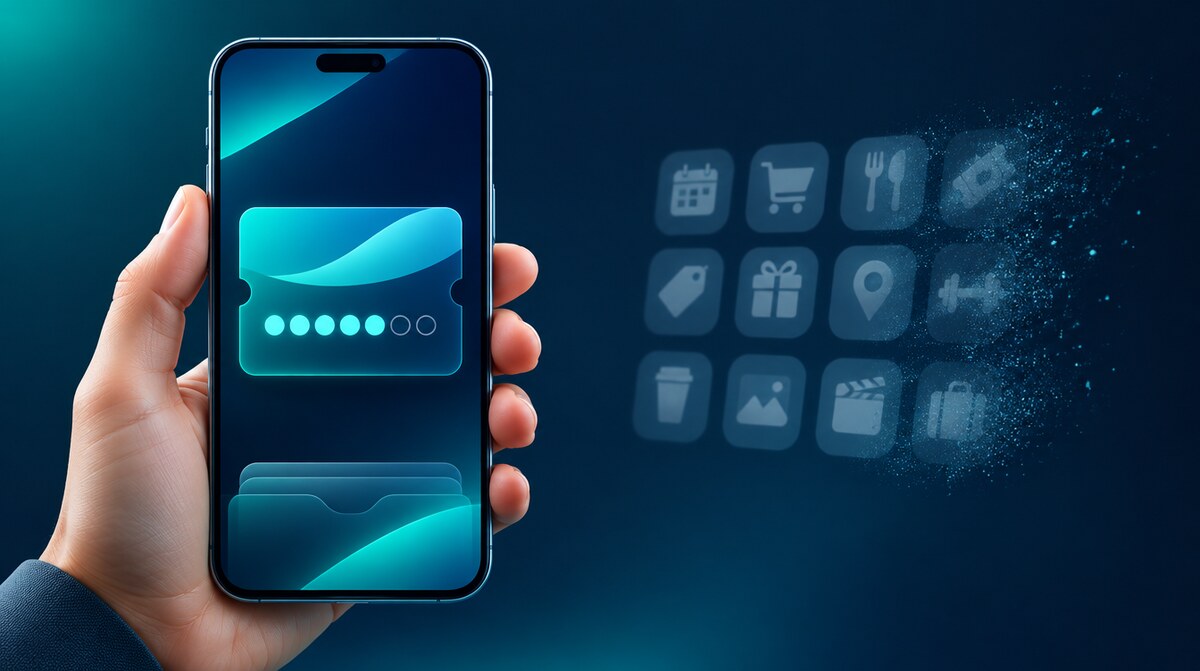
When a UAE business owner decides it's finally time to reward regulars properly, the search almost always starts the same way: "best loyalty app for small business." It feels like the obvious move — customers live on their phones, so loyalty should live in an app. But here's the uncomfortable truth the app vendors won't lead with: for most cafés, salons, gyms and shops, the app is where loyalty programs go to die. There's a second option — a digital loyalty card that lives in Apple Wallet or Google Wallet — and once you put the two side by side, the choice gets surprisingly easy.
What a Loyalty App Promises — and What Actually Happens
The pitch is seductive: your own branded app, your icon on the customer's home screen, push notifications, a points balance, maybe ordering built in. And for a handful of giants with daily-habit products, it genuinely works.
For everyone else, the same story plays out. You ask a customer at the till to download your app. That means: open the store, search, tap install, wait, create an account, verify an email, set a password — all while a queue forms behind them. Most people politely say "I'll do it later." Later never comes. The few who do install it open it once, then the app sinks to a folder on page three of their home screen, and a month later a storage cleanup deletes it. We've written before about why customers don't download apps — the short version is that people guard their home screens fiercely, and a business they visit twice a month doesn't make the cut.
Meanwhile you're paying for that app every month — development or subscription fees, app store listings, updates every time Apple or Google changes the rules. It's the most expensive way ever invented to collect stamps.
Loyalty App vs Digital Loyalty Card: The Side-by-Side
A digital loyalty card takes a different route. Instead of asking customers to install something new, it moves into an app they already have: Apple Wallet or Google Wallet, pre-installed on effectively every phone that walks through your door. Here's how the two compare where it matters:
Joining. App: search, download, sign up, verify — two to five minutes of friction, mostly abandoned. Wallet card: point the camera at a QR code by the till, tap once, done. Fifteen seconds, no account, no password, no form.
Staying. App: competes for home-screen survival and loses. Wallet card: sits next to the customer's bank cards — the one screen nobody ever cleans up. It can't be "uninstalled in a storage purge" because it isn't an install.
Messaging. App: push notifications work only while the app stays installed and permissions stay on. Wallet card: wallet push notifications land on the lock screen for as long as the card is in the wallet — and they're free, unlike the 10–30 fils you pay for every marketing SMS.
Cost. App: development or platform fees, maintenance, store compliance. Wallet card: a modest subscription and nothing else — no hardware, no POS change, no reprints. The full cost picture isn't close.
Setup. App: weeks to months. Wallet card: an afternoon. Design the card, set the rule — a digital stamp card, points, or a member tier — print the QR, brief the team with one sentence.
When an App Actually Makes Sense
Honesty matters here: apps aren't always wrong. If you're a large chain where customers order ahead and pay through the app several times a week, the app earns its home-screen spot because it does a daily job — the loyalty points are a bonus, not the reason it's installed. If that's you, build the app.
But notice what's doing the work in that story: frequency and function, not loyalty. A neighbourhood salon a customer visits every three weeks, a restaurant they book monthly, a gym, a barbershop, a boutique — none of these can win the download battle, and none of them need to. The loyalty job — remember me, count my visits, reward me, reach me — fits on a wallet pass completely.
The Question That Decides It
Strip away the vendor pitches and the decision comes down to one question: will your customer do the work to join? Every step you add — download, sign-up, password — cuts your member list in half. The business asking for a fifteen-second scan signs up the whole queue; the business asking for an app install signs up the die-hards and loses everyone else. A loyalty program's value is the list, and the list is built at the join moment.
That's why the wallet card quietly wins for small and mid-sized businesses: it doesn't ask your customer to adopt anything. The phone they already carry, the wallet already on it, one scan — and from that moment you have what the app promised all along: your brand on their phone, a visit count you can see, and a free channel to bring them back.
Skip the App. Keep the Loyalty.
If you've been putting off loyalty because "we'd need an app," you've been waiting on the wrong requirement. A digital loyalty card in Apple Wallet and Google Wallet gives you the member list, the stamps, the tiers and the lock-screen messages — with none of the download friction and none of the app bills. Set it up in an afternoon with Wally, put the QR by the till, and let the next customer in the queue become the first name on a list you actually own.