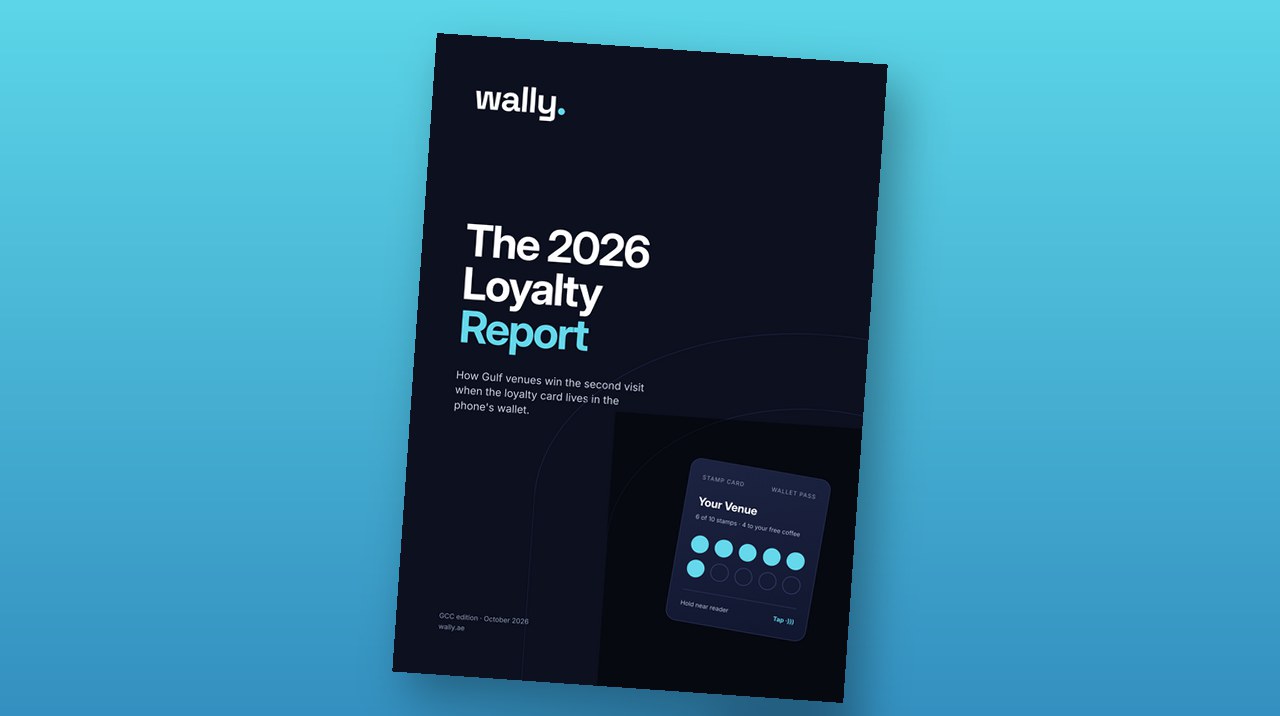
Gulf consumers want loyalty programmes — and are tired of what most of them ask in return. That contradiction is the starting point of The Wally 2026 Loyalty Report, our new 13-page GCC edition on how cafés, restaurants, salons, gyms and venues win the second visit when the loyalty card lives in the phone's wallet. It's free, and every statistic in it comes from a published third-party source.
Below is the short version: the six numbers that frame the report, the argument it makes, and what's in each chapter. If you'd rather read the whole thing, tell us where to send it above.
The Six Numbers Behind the Report
| Figure | What it measures | Source |
|---|---|---|
| $5.6bn | Forecast Middle East loyalty market by 2030, up from $3.4bn in 2026 — about 12.8% a year | ResearchAndMarkets.com, via Khaleej Times |
| 62% | UAE consumers more likely to shop with brands that offer a loyalty programme | Adyen UAE Retail Report 2025 |
| 55% | UAE consumers who say loyalty programmes often ask too much time, effort or data | Adyen UAE Retail Report 2025 |
| 70.7% | UAE residents who say they have become more willing to pay with a digital wallet | SixthFactor survey, 2026 |
| 85% | Share of Saudi retail payments that were electronic in 2025, up from 79% in 2024 | Saudi Central Bank (SAMA) |
| 23% | UAE retailers planning to launch a loyalty scheme within a year; 37% already run one | Adyen UAE Retail Report 2025 |
Put together, they say one thing: demand for loyalty is not the problem. The format is.
The Loyalty Gap: Customers Want the Reward, They Resent the Work
Adyen's UAE research captures the contradiction neatly. 62% of shoppers favour brands with a programme. Yet 55% say programmes ask too much, and 53% say they rarely offer rewards people actually want.
The report's reading is that the gap isn't about generosity. It's about friction at the moment of joining and relevance at the moment of reward. Every extra step between "would you like to join?" and a live card — an app-store download, an account, an email verification, a long form — loses customers while a queue is waiting. And a reward the customer can see and reach soon beats a balance they have to calculate. "Four more visits to a free coffee" is a complete sentence. "You have 340 points" is not.
The gap is not about generosity. It is about friction at the moment of joining and relevance at the moment of reward.
The Phone Is Already the Wallet
Payment behaviour in the Gulf's two largest markets has already moved. In the UAE, 70.7% of residents surveyed by SixthFactor say they've become more willing to pay with a digital wallet. In Saudi Arabia, SAMA reports electronic payments reached 85% of retail payments in 2025, with transactions rising from 12.6bn to 14.6bn.
That changes where a loyalty card should live. When the phone is already in the customer's hand to pay, a pass in Apple Wallet or Google Wallet sits one swipe from the card they pay with — no second app to find, no plastic to forget, no phone number to spell out to a cashier.
The report doesn't hide the weaker spot in the data: willingness is 16.4 points lower in households earning under AED 10,000 a month than in those earning AED 30,000 or more. A programme meant for every customer should keep a fallback, such as a QR code on the pass that staff can scan.
Most Venues Don't Need an App
A dedicated app is the right answer for a brand customers open every day. For a neighbourhood café or a salon visited once a month, the report calls it "an expensive way to be forgotten." Airship's survey of 11,000 consumers found 49% of UK respondents decide whether to delete an app after only a couple of uses — while immediate discounts and loyalty points were the notifications people most willingly accept. Customers want the reward; they're less keen on the container. (We've made the longer case in why customers don't download apps.)
Chapter 4 compares the three formats side by side:
| Paper stamp card | Branded app | Wallet pass | |
|---|---|---|---|
| To join | Take a card | Find, download, register | Scan a QR code or tap a link, add to wallet |
| Cost to build | Printing | Design, development, two app stores, upkeep | A pass template |
| Balance | Whatever is on the card | Live | Live, updated on the pass |
| Reaching the customer | Not possible | Push, if permitted | Pass updates and lock-screen notifications |
| Fraud and loss | Easy to copy, easy to lose | Low | Low; tied to the device |
This comparison is Wally's own assessment of each format, not survey data — and the report labels it that way.
What Else Is Inside
How a wallet pass works. Four moments, no download: enrol from a QR code, tap or scan at the till, watch the stamp count update on the pass itself, and return when a change surfaces on the lock screen.
A playbook by venue type. Starting mechanics for cafés and quick service, restaurants, salons and spas, gyms and studios, hotels and venues, and retail — from a digital stamp card with a reachable free item to membership passes with check-in by tap. Plus three rules that hold everywhere: make the first reward close, train the ask, and message rarely but usefully.
The six metrics that matter. Enrolment rate, active pass rate, time to second visit, visit frequency, redemption rate and member spend lift — with the formula for each and a warning about reading lift too generously. It pairs well with our guide to measuring loyalty program success.
A 90-day plan. From paper card to live programme in a quarter: take stock, design one earn rule and one reward, launch at the till, then tune against the numbers — with a ten-point launch checklist. If you're starting from zero, read it alongside how to start a loyalty program.
How We Wrote It
The report contains no proprietary Wally customer data. Every figure is quoted as published by its source — ResearchAndMarkets.com, Adyen, SixthFactor, the Saudi Central Bank, Airship and IMARC Group — and listed with links on the final page. Where we give an opinion, it's labelled as a recommendation. We'd rather hand you numbers you can check than numbers you have to take on trust.
Get the 2026 Loyalty Report
If you run a café, restaurant, salon, gym or venue in the GCC and still hand out paper cards — or you're weighing up the cost of an app — this is the briefing to read first.
And when you want to see what a pass looks like in your own brand, book a short demo — we'll start with one card.